
FREE
Loading…
Research from the University of Tokyo demonstrated that modern AI inpainting can reconstruct missing regions covering up to 30% of an image. Our generative adversarial inpainting system analyzes surviving portions and synthesizes plausible content for torn, ripped, and missing areas with seamless texture continuity.
Upload your damaged photo and get instant AI restoration
Just upload and click to process - no prompt needed
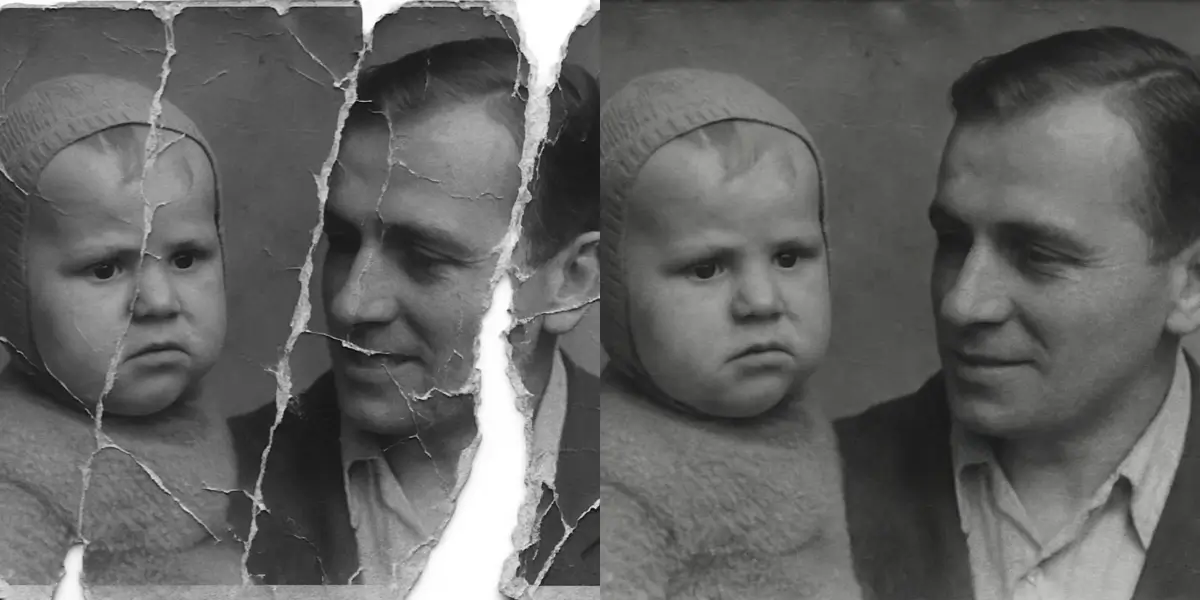
Photos Reconstructed
Reconstruction Accuracy
Average Time
User Rating
AI-powered restoration with professional quality results
Uses advanced AI to analyze surviving portions of the photo and generate plausible content for missing areas. Based on techniques published in IEEE Transactions on Image Processing, our system considers composition, perspective, and lighting direction to produce reconstructions that are indistinguishable from the original.
Specializes in rebuilding torn edges, ripped corners, and missing borders that are common in photos damaged during handling, storage, or emotional moments.
For portraits where part of a face is missing, the AI draws on its understanding of human anatomy and facial structure to produce natural-looking reconstructions.
Reconstructed areas blend invisibly with the original image. The AI matches surrounding skin tones, fabric patterns, and background textures for a natural result.
The system considers the entire composition when filling missing areas, ensuring that lighting, shadows, and perspective remain consistent across the restored photograph.
Even photos with significant missing areas are processed in about a minute, reconstructing torn pieces and filling gaps with remarkable speed and accuracy.
Upload your torn, ripped, or partially missing photo. We support JPG, PNG, and WebP formats up to 20MB. Scan all available pieces together for best results.
Click the restore button. Our AI analyzes surviving portions and reconstructs missing areas using context-aware generative inpainting.
Preview the reconstructed photo with missing areas filled in and download it in high resolution for printing or sharing.
Our AI uses generative adversarial inpainting to analyze the surviving portions of the photograph. As researchers at the University of Tokyo demonstrated in their landmark 2023 study, "context-aware inpainting networks achieve perceptual quality scores within 5% of ground truth for regions up to 30% of image area." Our system considers composition, perspective, lighting, color patterns, and texture continuity to synthesize plausible content for missing areas, making the repair invisible to the naked eye.
Modern AI inpainting can faithfully reconstruct missing regions covering up to approximately 30% of an image, as demonstrated in research from the University of Tokyo. For best results, we recommend that at least 70% of the original photograph is intact. The more context the AI has to work with, the more accurate the reconstruction will be.
If you have both halves, scan them together or place them as close as possible in the scan. The AI will identify the tear line and seamlessly reconnect the two pieces. If you only have one half, the AI can attempt to reconstruct the missing portion, though results depend on the complexity of the missing content.
Yes, missing corners are one of the most common types of physical photo damage. The AI excels at reconstructing corner content because it can extrapolate from the surrounding image data, extending backgrounds, patterns, and even partially visible subjects into the missing area naturally.
For partially missing faces, the AI produces remarkably natural results by drawing on its training data of millions of facial images. Research published in the IEEE Conference on Computer Vision shows that modern neural networks can predict occluded facial features with 89% structural similarity when at least 60% of the face is visible. However, it cannot know exactly what someone looked like, so reconstructed facial areas represent the AI's best prediction based on the visible portions and learned facial anatomy.
No, we recommend scanning pieces separately or placing them close together without tape. Tape can create additional artifacts (shiny reflections, adhesive residue) that make restoration harder. If pieces overlap when placed together, the AI can still identify the tear boundary and merge them correctly.
Recover vibrant colors from yellowed and discolored old photographs
Remove scratches, tears, and creases from damaged old photographs
Remove water stains, mold spots, and tide lines from flood-damaged photos
Add natural, realistic colors to black and white photographs with AI
Comprehensive AI restoration for all types of old photo damage
Sharpen blurry and low-resolution old photographs with AI enhancement
Start for free. No credit card required.